50 Years of Operation


|
50 Years of Operation
|
|
|
|
Numerous changes were made to the IDS airframe in the conversion to the ADV/F.3 the nose assembly was lengthened to incorporate the air to air radar package.
|
|
A plug was also inserted into the fuselage just behind the cockpit, this introduced a further fuel tank and avionics bay. It also meant that that four skyflash missiles could be semi recessed into the lower fuselage.
|
|
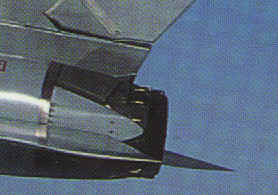
The solution to the engine problem was cured by the on going development of the RB199 engine. By utilising a longer jet pipe and a revised fuel delivery system the thrust of the engine was significantly increased. This also accounts for the slightly different arrangement of the F3s rear fuselage.
|
|
The F2/F3 also has a RAT in case of electrical failure, the GR1/GR4 foes not.

The F.3 is a very capable machine in the right hands and many 'state of the art' aircraft have been successfully defeated in mock combat. A number of upgrades have been applied to the fleet to ensure that it can maintain its effectiveness. The JTIDS(Joint Tactical Information Distribution System) system enables the sharing of information between Tornado and Intelligence gathering aircraft such as the E3 AWACS enabling the aircrew to maintain a higher level of situational awareness which can be the difference between life and death.
A number of airframes are passing through the CSP (Capability Sustainment Program) program which sees a number of changes to both the wiring, hardware and software systems to allow the F.3 to deploy state of the art weapons systems.
All active airframes were brought up to or built as Stage 1, from ZE936. The stage 1 upgrade included an F/A18 type stick top providing improved HOTAS capability. Stage 1+(Gulf War Modifications) was also adopted fleet wide and included modifications to the canopy, hot weather tyres, uprated air conditioning, chaff/flare dispensers and radar absorbent material, the automatic wing sweep mechanism was also deactivated.
A number of airframes are also having their highly stressed centre section replaced under the FFLTP program. ZE839 was the first F.3 to undergo this rejuvenation during 2001.
Radar
The AI.24 Foxhunter radar had a troubled birth, it was beset with a large number of problems during its inception that resulted in early airframes having to have lead ballast fitted instead of the radar units. The radar was initially air trialled in a Buccaneer and Canberra. It first flew in Tornado, ZA283, on the 17 June 1981 almost a year behind schedule. To be fair some of the delays in this program were due to changes being introduced to the specification after the base specification had been drawn up.
The first twenty production standard radars were delivered in 1983 although complete airframes did not leave Warton until 1985. The initial sets were prone to jamming, this was due to the methods used to transmit and various issues to do with meeting the proposed requirement.
By 1990 the radar standard was such that it almost met the design specifications, this was not actually true until the advent of the Z standard. A number of standards were produced beginning with the Type W of which 70 were produced. These were fitted to airframes in blocks 8 - 10. The W standard was followed by the Z standard of which 80 were produced, these were fitted to to airframes from blocks 11 and 12. A further 76 units were produced for the last batch of RAF airframes and for the RSAF airframes. Most of the W standard units were upgraded to the Z standard.
Further development resulted in the Stage 1 unit which incorporated improved cooling and revised software. The software was also applied to the Z standard units.
Further upgrades have also taken place which again utilise revised software and upgraded processors to improve performance this is known as the Stage 2.
The antennae is of the Cassegrain type and is controlled by hydraulic servos which provide a high degree of control even when subjected to high levels of G.
|
|